Exerpt adapted from my book, Living the Palio. (It’s already written, so I’m happy to share it here.)

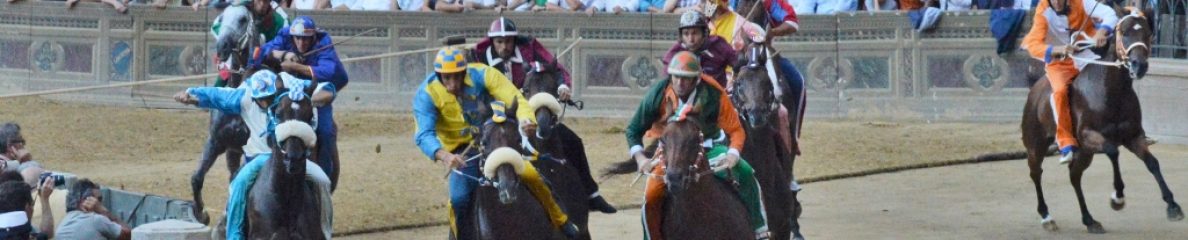
To understand the Palio race, one should become acquainted to some extent with Siena’s seventeen distinct neighborhoods, known as contrade (plural form of contrada). Without the contrade, the Palio would simply vanish or, perhaps even more horrific, devolve into a mere reenactment for outsiders. The Palio and contrade operate hand in hand, each mutually dependent upon the other.
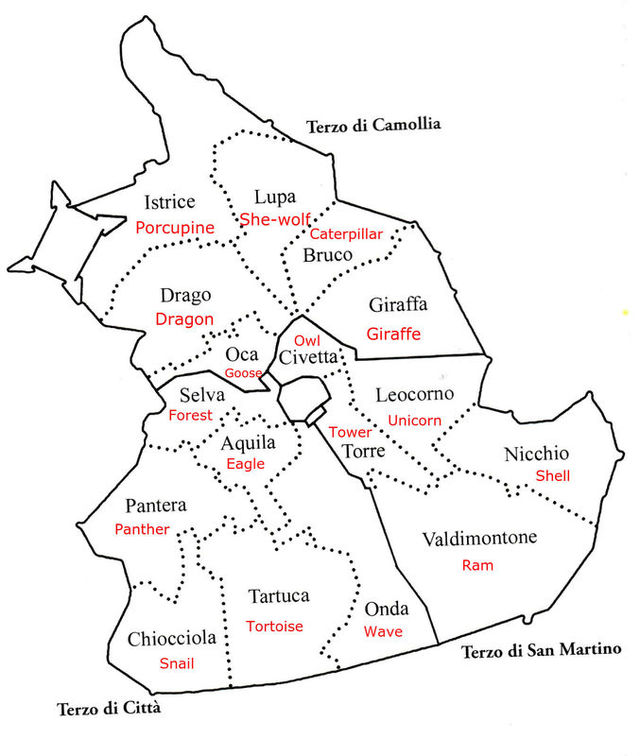
Each contrada occupies its own geographic rione (territory) within the city walls (see contrada map below). Further, each enjoys its own local government, elected officials, flag, constitution, and political jurisdiction within its geographic boundaries. Put another way, each neighborhood comprises a miniature city-state, and each revolves intently around the annual cycle of the Palio. For this reason alone, visitors struggle to find meaning in the race, not really having a good reason to cheer for one particular contrada’s horse over that of another. Without an emotional attachment to a particular contrada—in the way one might identify with certain sports teams—one’s decision to cheer on, say the Porcupine contrada’s horse over that of the Snail, would be just as random as choosing a gelato flavor while blindfolded.
Contrade Relationships
Further, each contrada has its own allies and usually its own longtime rival or enemy. There are actually four types of relationships possible between the contrade: alliance, friendship, no relationship, and enmity. The relationships can change over time, for instance from no relationship to friendship—as when one contrada assists another in realizing a Palio victory. Five of the contrade are not currently part of a reciprocal enmity pair, those of the Wave, Dragon, Forest, Caterpillar, and Giraffe. The traditional rivalry between the Giraffe and Caterpillar contrade was annulled through a “peace treaty” in 1996. Is there any doubt that these communities view themselves as miniature city-states?
The following list details the traditional contrada enemies:
- Tower—Goose
- Porcupine—She-Wolf
- Snail—Turtle
- Shell—Ram
- Caterpillar—Giraffe (annulled with a peace treaty in
1996) - Eagle—Panther
- Owl—Unicorn
It stands to reason that the potential for hostility and contentiousness intensifies when more pairs of rivalries face off during a given Palio. Like the Palio itself, contrada members consider their traditional enemies with varying degrees of seriousness, given the wide range of responses I received throughout our sojourn. Speaking to my colleague, one male landlord in the Owl made it clear that the sense of animosity toward their archrival, the Unicorn, ramps up to “hatred” levels only around Palio time. At most other times rival contrada members get along just fine, more or less. In fact, one popular butcher from the Unicorn maintains his shop in the Owl and regularly provides meat for them, employing dangerous butcher knives and all. (End of Excerpt)
 The Siena Visitor
I noticed in the new series Tucci in Italy that the Contrade all have sciarpe with their colors on them. How can you buy these?
LikeLike
Hi, thanks for alerting me to the Tucci episode, which I will look for. In brief here, contrada members (i.e. the Sienese overall) refer to the scarves as “fazzoletti” (plural for “fazzoletto”). The ones sold for tourists in the Campo or in souvenir shops are slightly different than the official fazzoletti of the contradas. As long as visitors are not trying to pretend to be contrada members, it’s ok to wear them for fun. The official ones are only available from the contrada “societa,” or clubhouses, and often cost 35-50 euro if they are willing to sell them to you. (You may wish to check out my other post about the fazzoletti, called “Why do the Sienese Wear Neck Scarves.” Ciao, Tom
LikeLike